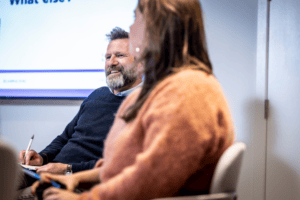
A surgical team, a Formula 1 pit crew, a leadership team: they run not only on what everyone can do, but on knowing who knows what. Psychologists call it transactive memory. You don’t have to remember everything yourself, because you know who to turn to.
Now a new colleague joins the table. Always available, looks competent and rarely pushes back. What does that do to a team?
What the research says
Researchers led by Kate Niederhoffer and Jeffrey Hancock surveyed 1,033 US knowledge workers on project teams. Their findings were published in Harvard Business Review on 15 October 2026. The picture is mixed:
- The more a team uses AI, the more people feel their colleagues hold specialised knowledge. Good news.
- But people who turn to AI instead of a colleague see trust and coordination drop. In teams where that is the norm, both score more than 20% lower.
- One in five would rather ask AI than a colleague. Nearly half (49%) say colleagues sometimes replace them with AI. People who feel that way feel less important to the team and are more likely to look for another job.
The researchers have a name for it: relationslipping. Working relationships that quietly slip away.
It is not an AI problem
Strikingly, the researchers do not blame the technology. People with low psychological safety in their team are more than twice as likely to turn to AI. Better a weaker answer from a model than the risk of looking stupid. On top of that, AI is built to agree with you, which makes a real conversation, friction included, feel harder.
We recognise that. What goes wrong in teams rarely sits in the tool. It sits in what goes unsaid.
Three questions for your next team meeting
- Who do you ask first: AI or a colleague? People often pick AI because it feels safer: no judgement, no interruption. What does that say about safety in your team?
- Does your team still know who really knows what? AI makes everyone look like an expert on everything. Would you notice if that overview disappeared?
- Who in your team feels replaceable now that colleagues would rather ask AI? What do you hear about it, and what don’t you hear?
They are allowed to be uncomfortable. Listen above all to what goes quiet.
What helps
- Stay in daily contact, even briefly and asynchronously. In teams with daily contact, coordination (+28%) and trust (+19%) were clearly higher, even among heavy AI users.
- Build psychological safety. Asking a colleague should feel as safe as asking a model.
- Make AI use something you talk about. Share how you use it, what works and what doesn’t.
- Reward the team, not just the AI-savvy individual.
- Use AI to prepare for a difficult conversation, not to avoid it.
AI doesn’t cause it. It does change how we relate to each other. Whether it makes your team stronger or weaker is a choice you make together.
Recognise this in your team? Rather talk it through first? Email hello@beanmachine.be. No pitch, just an honest opinion.
Inspired by the article “Team Dynamics Weaken When Employees Turn to AI Instead of Colleagues” by Kate Niederhoffer, Kristina Rapuano, Alex Liebscher, Alexi Robichaux and Jeffrey T. Hancock, published in Harvard Business Review on 15 October 2026. The survey reports self-reported associations, not proven causes.